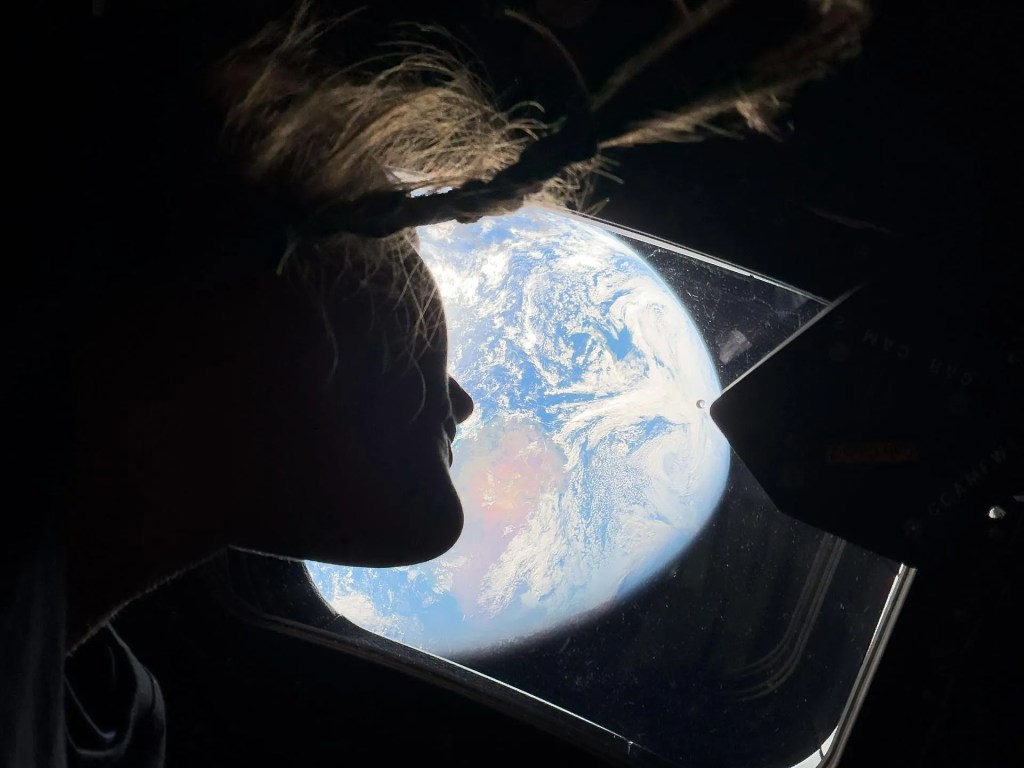
Like most of the world, I have been obsessed with the Artemis II mission. Like most folks in mental performance and performance psych I have been trying (and failing) to create a quirky post about how this mission around the moon can be applied to sport psychology and translatable to meaningful lessons in performance.
At lunch, sitting at the long community cafeteria table for the professional soccer club I work at, I opened my laptop and showed the live stream I have almost religiously been watching in my spare time. While our setup has three big screens showing various sports, I was able to catch attention of a few younger players as they sat next to me.
“You know, it was fake. The moon landing. It’s not real.”
The athlete next to me said, in a playful way, after I had explained Artemis II and the entire mission since he wasn’t aware of what was going on. Other players chimed in, agreeing – some that were aware of the current lunar mission. I was being playful back “you’re not real!!” while being completely surprised at the sheer majority of young men I was around that didn’t believe the original moon landing had actually happened.
To be clear, I have heard the conspiracies – filmed in a desert in New Mexico, done in a Hollywood basement studio… but to see the agreement amongst my Gen Z counterparts really surprised me. One athlete with whom I have a strong rapport said, “Lacey, do you trust the government is always telling you the truth?” He brought up a strong point, and while this is not a political post it is telling me something about systems of power and trust.
Dominant power structures combined with ambiguity – let’s sprinkle in adverse experiences due to life circumstances like race, gender, disability, geolocations, sport systems, and regular “being a person is hard” type stuff – are not structures that yield a lot of faith for the folks below them.
Most people need simple things to thrive. They need to feel connected to others or to the thing they are doing (I matter), they need to have autonomy or at the least agency of how they can move within constraints (I can still do), and they need to feel like they have the information they need in order to choose what they do and who they do it with (I know).
In sport psychology, we know this equation as self-determination theory.
That conversation had me thinking about a few things I’ve come across recently. One was a colleague of mine, Dr Bryan Rojas-Arauz in his an amazing presentation about navigating uncertain times: “athletes want to know that you care before they want to know what you know.” The other, that I think of often from when I worked with Piers Kowalski when he reminded me while teaching me “remember, your experience is not their experience.” And then, of course as a disabled practitioner the constant idea of how do we approach complicated concepts in an accessible way? Especially as the neurodiversity on any team can feel apparent, but even more so when you combine different non-traditional education settings and global experiences athletes in this particular environment bring to the group.
This young cohort of athletes and talent are so different than us – which is great! Diversity is the spice of life, it’s what makes an organism strong and it’s what brings solutions to complex issues.
As practitioners it’s easy for us to get lost in the sauce of academia, theories, models, assessments and surveys – but before we apply all of the modalities and educate I think we need to pulse check on our rapport with our targeted audience. Because to be honest, I don’t know and can’t prove if the moon landing was real. I don’t think that’s the point, because to athletes at least – the trust you either have (or don’t) with them – is what’s real.
You are the vehicle of your work, and just like Artemis II, I hope you go further than ever before.
L.
 Lacey J Henderson
Leave a comment